Guests spend about ten seconds with your seating chart. In that time they need to find their name and their table number. Everything below starts from that job.
Readability first
- Size. For 80–150 guests, a board of at least A1 (594 × 841 mm) or 24 × 36 in. Over 150 guests, consider two boards or A0.
- Type size. Names should be readable from about a metre away. As a rough guide, keep names at 18 pt or larger on an A1 board.
- Contrast. Dark text on a light background is easiest to read in evening light. Gold foil on mirror looks lovely and is hard to read; test it in the actual light of the room.
- Order. Alphabetical by surname is fastest for guests. By table looks more elegant and is fine for smaller weddings.
Layout ideas
Alphabetical columns. Every guest listed A to Z with the table number beside the name. Fast to scan, ideal for large weddings.
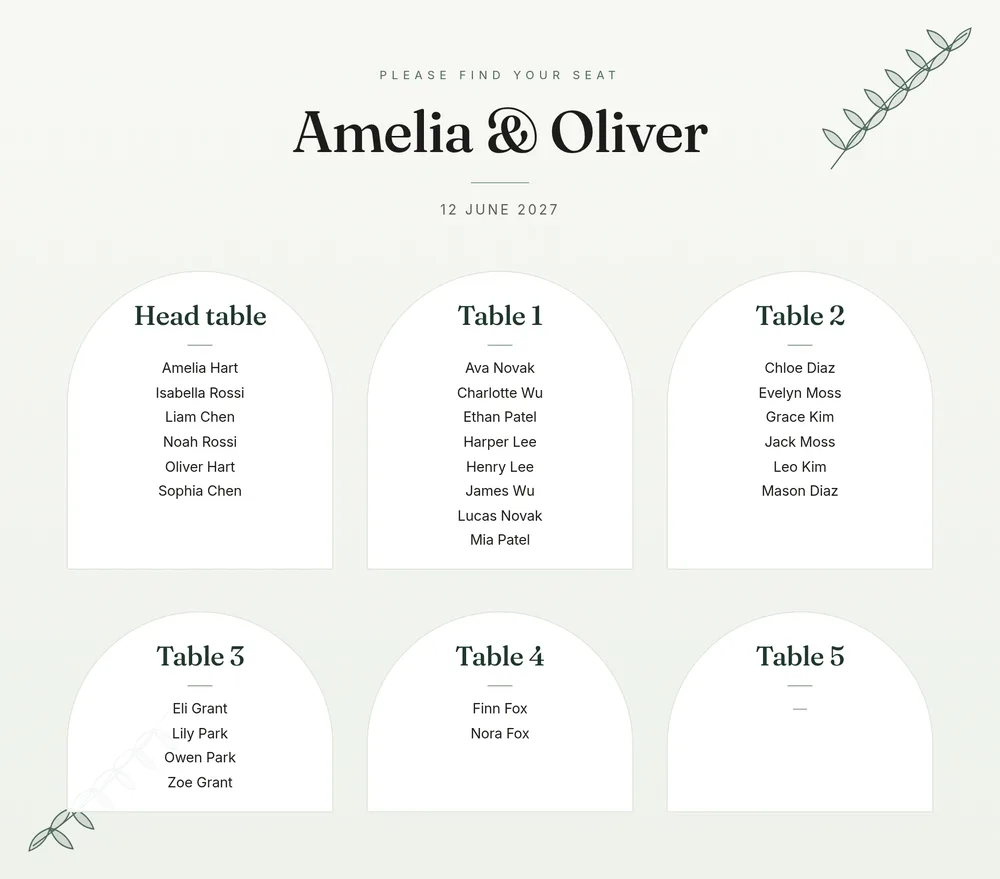
Table blocks. Each table as a block with its guests listed underneath. Easy to check, pleasing to look at, and it lets guests see who else is at their table.
Floor plan. A small map of the room with numbered tables, alongside either of the above. Helpful in large or irregular rooms.
Export your chart in one of three print styles, ready for a print shop.
Start planning freeMaterials
- Foam board or card from a print shop — affordable and light, easy to put on an easel.
- Acrylic panels with printed or painted names — elegant, but plan extra time.
- Wood, chalkboard or mirror — pretty and personal, but hand-lettering 150 names takes many hours. Allow for corrections.
- A frame with individual cards or tags — escort cards hung on strings or a grid. See escort cards vs place cards.
Placement
- Near the reception entrance, not inside the doorway where people stop and block the flow.
- At eye level on an easel, with space in front for a few people to stand.
- Lit well. If the room is dim, ask the venue for a light on the sign.
- Duplicates for large weddings. Two signs on either side of the entrance halve the crowd.
Theme ideas
- Match your stationery. Reuse the fonts and colours from your invitations.
- Name tables instead of numbering them — places you have travelled, favourite books, songs — and list the table names on the sign. Keep numbers on the tables as well so the caterer can follow the plan.
- Botanical frames with a simple greenery border work in almost any venue.
Avoid last-minute reprints
Order the sign late enough to include final changes and early enough for the print shop: many need two to five working days for large formats. Proofread names with someone who knows both families, and keep one spare escort card or sticker label for an emergency correction. The seating chart timeline shows where printing fits.
Make the file
SeatFinch exports your finished plan as a PDF or a PNG (rendered at 2× scale) in three styles (classic, modern and botanical). Send the PNG to a print shop for large formats, or print the PDF at home. Prefer to draw it yourself? Our free templates include blank seating chart posters in A3, A2 and A1.
Last updated 2026-11-02