A round table seating chart is the most common layout for wedding receptions, gala dinners and banquets. Rounds make conversation easy because every guest faces the centre, they photograph well, and they fit around a dance floor with natural walkways between them. Their weakness is space: rounds use more floor area per guest than long tables, so knowing your sizes matters.
How many guests fit at a round table
| Diameter | Comfortable | Snug | Typical use |
|---|---|---|---|
| 48 in (122 cm) | 6 | 8 | Small rooms, family tables |
| 60 in (152 cm) | 8 | 10 | The standard wedding round |
| 66 in (168 cm) | 10 | 11 | Common in hotels |
| 72 in (183 cm) | 10 | 12 | Large families, Chinese banquets |
A comfortable place setting needs roughly 24 in (60 cm) of table edge. The circumference of a 60-inch round is about 188 in, which gives a little over 23 in each for eight guests — comfortable — and under 19 in each for ten, which is tight but common at banquets.
Laying out round tables
- Start with fixed features. Mark the entrance, the dance floor, the bar, the stage or DJ and any pillars. Tables go in the space that is left.
- Put the couple’s table where everyone can see it. Usually on the far wall from the entrance or at the edge of the dance floor.
- Grid or staggered. A straight grid is efficient and easy for servers. A staggered (offset) layout looks more relaxed and gives more guests a sightline to the head table.
- Leave aisles. About 5 ft (1.5 m) between table edges lets chairs push back and servers pass. Keep wider main aisles from the entrance to the bar and restrooms.
- Ring the dance floor. Placing the first row of rounds around the dance floor keeps the party in the middle of the room.
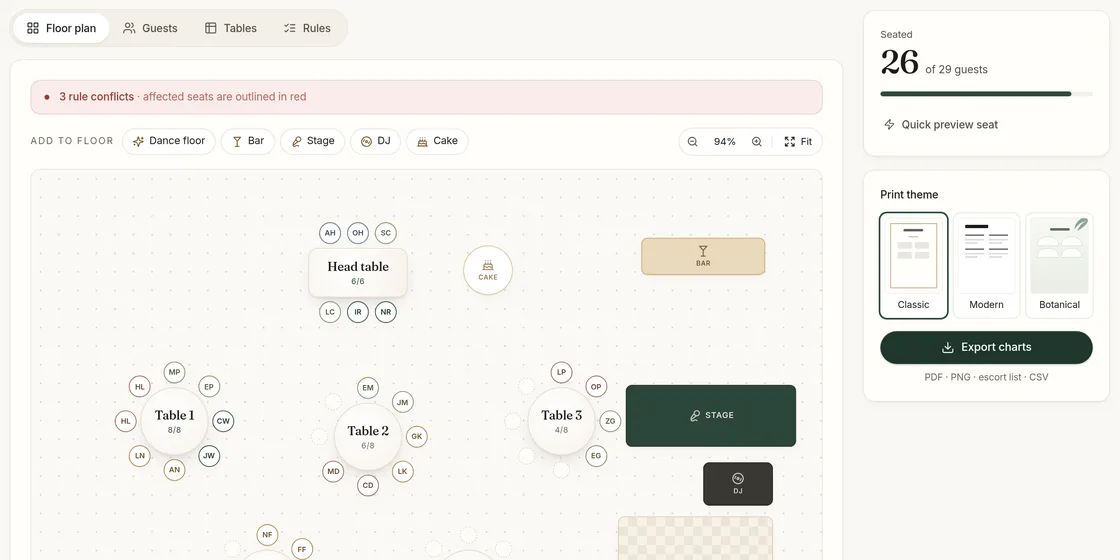
In SeatFinch you can add a dance floor, bar, stage, DJ booth and cake table to the floor plan alongside your rounds, so the plan looks like the room you will walk into.
Lay out your round tables and auto-seat your guests — free.
Start planning freeSeating guests at round tables
Round tables reward balance. Every guest can talk to everyone, so a table with one isolated guest is more noticeable than at a long table, where people mostly talk to their neighbours.
Seat couples together, side by side. At rounds, partners usually sit next to each other rather than across.
Aim for at least two connections per guest. Each person should know at least one other person at the table, ideally two.
Fill tables evenly. A round of 10 with 7 guests looks half-empty. If numbers don’t divide well, use a smaller round for the remainder — SeatFinch lets each table have its own capacity.
Keep households whole. Use the household column in your guest list so families are not split across tables; the auto-seater treats each household as one unit.
Round vs rectangular
Rounds are best for mixing groups and for receptions with a dance floor. Long tables seat more people in a narrow room and create a family-style feast. Many weddings combine both. Compare them on the rectangular table seating chart page, and use the table calculator to see how many of each you would need.
Round tables at Chinese wedding banquets
Chinese wedding banquets almost always use large rounds of 10 or 12, often with a lazy Susan in the centre for shared dishes. The head table is usually placed front and centre near the stage, with the two families’ tables on either side.
Last updated 2026-11-02