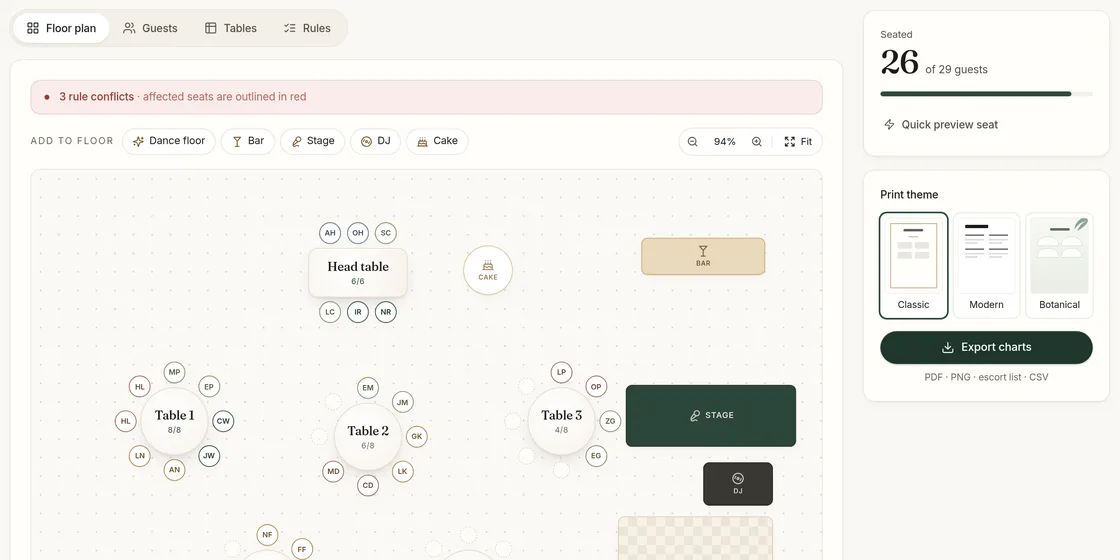
Rectangular tables — called banquet tables, trestle tables or long tables — are the classic choice for head tables, family-style dinners, barn and garden weddings, and rooms that are long rather than wide. Pushed end to end, they form a single long table that can seat an entire wedding party or even every guest.
Capacity of rectangular tables
| Table | Sides only | With ends | Typical use |
|---|---|---|---|
| 6 ft × 30 in (183 × 76 cm) | 6 | 8 | Head tables, small groups |
| 8 ft × 30 in (244 × 76 cm) | 8 | 10 | Banquet rows, family style |
| Two 8 ft tables end to end | 16 | 18 | Long feasting tables |
Leave the ends empty if centrepieces, candles or a serving station will sit there, or if guests will need to get in and out easily. Joining tables loses the seats at the inner ends.
Common long-table layouts
Head table. One long table facing the room, guests on one side only, so everyone can see the couple. Typical for the wedding party.
Banquet rows. Several long tables in parallel rows across the room. Efficient for large numbers, and easy for servers.
One long table. For smaller weddings, every guest at a single table creates a memorable dinner-party atmosphere. Allow about 2 ft (60 cm) per guest along each side.
U-shape or E-shape. Tables joined into a U or E around an open centre work well for speeches and for rehearsal dinners where everyone should see everyone.
Mixed. A long head table with round guest tables is one of the most common reception layouts.
Mix long tables and rounds on one floor plan — free.
Start planning freeSeating guests at long tables
Conversation at long tables is local. Guests talk to the people beside them and directly opposite; the far end might as well be another table. That changes how you seat people:
- Seat friends opposite each other, not just side by side. Each guest then has three easy conversation partners.
- Put lively guests in the middle. Energy spreads outwards from the centre of a long table.
- Keep couples together, but sometimes across. At family-style tables, partners opposite each other can both join the conversations on their side.
- Group by section. On a long table, think of each 6–8 seat stretch as its own "table" when you plan who sits near whom.
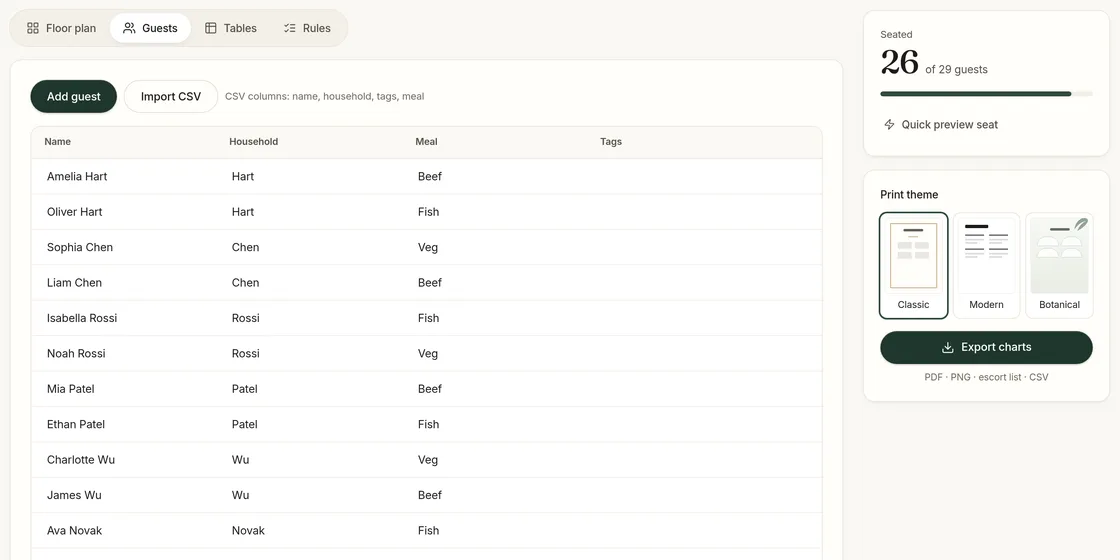
In SeatFinch, each rectangular table has its own capacity, and you can split a long run into several tables to control who sits in which section. Households and "must sit together" rules keep groups in the same stretch.
Rectangular vs round
In a long, narrow room, rows of rectangular tables usually seat more guests than rounds can, and they suit family-style service where platters are passed along. Rounds are better for mixing groups and for receptions built around a dance floor. See the round table seating chart page for round sizes, and use the table calculator to compare numbers.
Last updated 2026-11-02